Skip to content
Fuel Intelligence for Aviation

From supplier order to regulatory report, every gallon has one continuous, defensible record.

Flowmark connects fuel ordering, inventory, field execution, reconciliation, forecasting, and reporting through one operational record.

Built for

  • FBOs
  • Aviation operators
  • Multi-location networks
  • Fuel operations leadership

The fragmentation problem

Fuel moves continuously. Its data usually doesn't.

Orders, delivery tickets, tank readings, truck movements, aircraft uplifts, reconciliation, finance, and reporting often live across different people and systems. Flowmark connects those movements into one operational record.

  • Supplier orders
  • Delivery records
  • Tank inventory
  • Ramp activity
  • Reconciliation
  • Reporting
Flowmark — Fuel Intelligence for Aviation

One operational record

Every movement, connected

Inside Flowmark

One record, seen from every angle that matters.

01

Command center

Know what you have, what is committed, what is coming, and what requires attention.

Flowmark Operations Overview showing fuel position of 33,660 gallons, committed uplift, projected coverage in days, reconciliation status, compliance state and open exception count, above a management intelligence panel and a 30-day fuel throughput chart.
Flowmark · Operations Overview

The operating picture for a location or a whole network — inventory, commitments, coverage, and exceptions on one screen, drawn from the same record your teams work in.

  • Fuel position
  • Committed uplift
  • Projected coverage
  • Open exceptions
  • Upcoming flight demand
  • Deliveries & reporting status
02

Reconciliation

When the numbers differ, Flowmark shows why.

Flowmark reconciliation screen comparing a ledger-derived book balance of 8,175 gallons against a physical measurement of 8,110 gallons for Tank 02, with the −65 gallon variance shown as within a 3% tolerance and an unresolved variance exception listed beneath it.
Flowmark · Reconciliation

Ledger-derived book balance, physical measurement, and the configured tolerance sit side by side. A physical reading is recorded against the record — it does not silently overwrite the movement history behind it.

  • Book balance built from recorded movements
  • Physical measurement held separately
  • Variance against a configured tolerance
  • Unresolved variances raised as exceptions
03

Reporting

Report from the same record you operate from.

Flowmark reports screen listing an August Port Authority filing marked Not Ready with 55 source transactions and a July filing marked Accepted with 402 transactions frozen at submission, above a report library of operational, reconciliation, financial and compliance snapshots.
Flowmark · Reports

Filings carry their own state and the count of source transactions behind them. A submitted filing is frozen at submission, so what was filed and what the ledger says today are never confused for one another.

  • Filing state, from not ready to accepted
  • Source transaction count on every filing
  • Submitted filings frozen at submission
  • Point-in-time snapshots from the reconciled ledger

Flowmark Field

The record starts where the fuel moves.

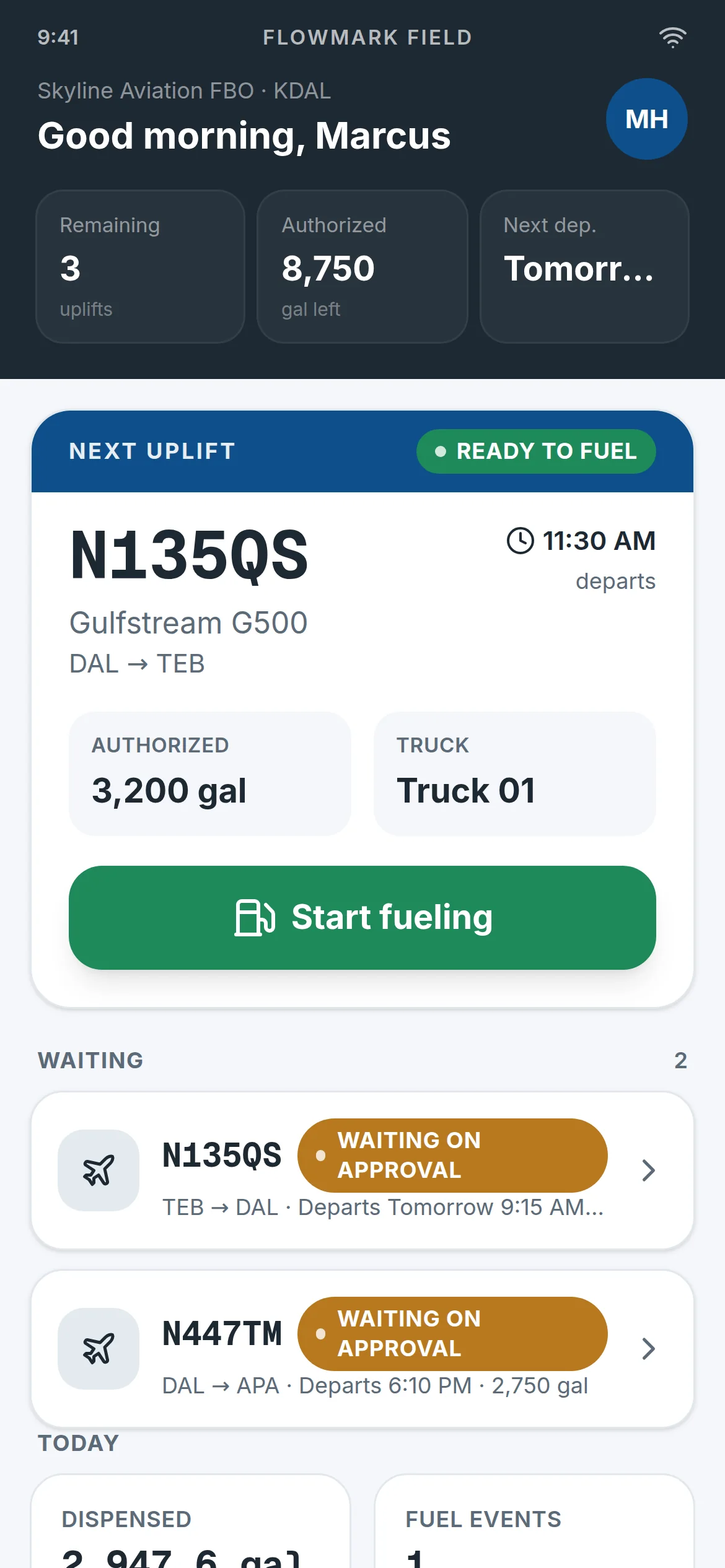
Capture operational truth on the ramp, not hours later at a desk. Aircraft and fuel-type verification, safety checks, meter start and end, and completion records are entered at the point of work.

  • Next uplift
  • Authorized gallons
  • Start fueling
  • Safety checklist
  • Meter start & end
  • Receive fuel
  • Transfer fuel
  • Tank reading

Captures are saved on the device when there is no signal, and sync to the ledger when service returns.

Flowmark Field on a phone, showing the next uplift for tail N135QS, a Gulfstream G500 departing at 11:30 AM, with 3,200 gallons authorized, Truck 01 assigned, a Start fueling control, and two further uplifts waiting on approval.
Flowmark Field · line service

The operating lifecycle

One gallon. One history.

Fuel moves through procurement, positioning, execution, control, and reporting. In Flowmark, every movement contributes to the same defensible operational record.

  1. 01

    Procure

    • Order
    • Confirm
    • Deliver
  2. 02

    Position

    • Receive
    • Store
    • Transfer
  3. 03

    Execute

    • Plan Uplift
    • Fuel Aircraft
  4. 04

    Control

    • Reconcile
    • Cost
  5. 05

    Report

    • Report
    • Submit

Continuous by design — no stage stands alone, and nothing is re-keyed between them.

Fuel operations intelligence

Ask Flynn

Ask operational questions against the same underlying record — and get answers you can trace, not guesses. Every response is derived from your movements, inventory, and reporting, and cites the exact records behind it.

Confidence
High, medium or low — with the reason when it is not high.
Answer
Computed from the ledger, not summarised from a document.
Evidence
The specific tanks, orders and transactions the answer rests on.
Open record
A direct route into the record itself, plus the suggested action.
  • Why is Tank 02 below reserve?
  • Explain this variance.
  • Which transactions contributed most?
  • Why is the August report not ready?
  • How much Jet-A is committed tomorrow?
  • Are any reports at risk?
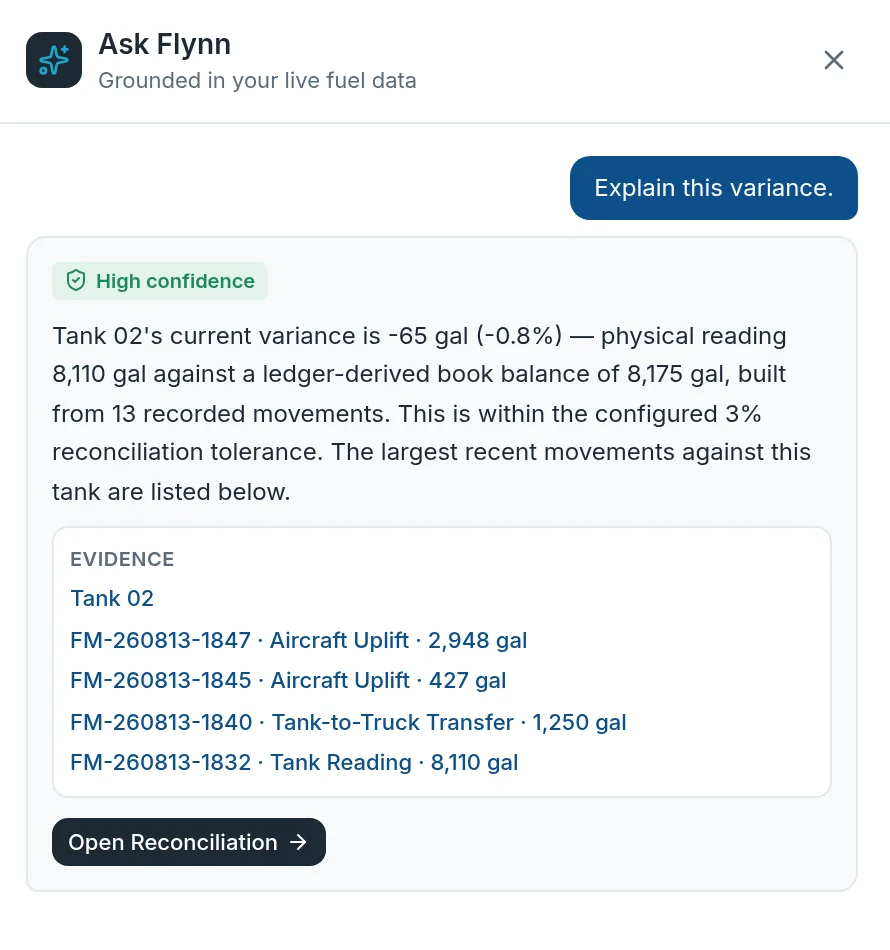
The Ask Flynn panel answering “Explain this variance.” with high confidence: Tank 02's variance of −65 gallons against a ledger-derived book balance of 8,175 gallons, built from 13 recorded movements and within the configured 3% tolerance, with four contributing transactions listed as evidence and a control to open the reconciliation record.
Flowmark · Ask Flynn, over the reconciliation record

Enterprise & control

Built for controlled aviation operations.

Flowmark is designed around traceability, role-aware workflows, configurable operational controls, and the systems aviation organizations already run.

Flowmark owns the fuel operational record — ordering through reconciliation and reporting — and hands clean, reconciled data to the enterprise systems you already run, rather than replacing them.

Integration-ready by design. Connections to external fuel systems, gauges, and enterprise software are configured per customer.

Identity & access

Roles the product enforces

Navigation, route access, and the operations a person can perform are all driven by the same role definitions — not by hiding controls in the interface.

  • General Manager
  • Fuel Operations Manager
  • Line Service Technician
  • Controller & Finance
  • Compliance Manager
  • Auditor
  • Administrator

Microsoft Entra ID single sign-on

Enterprise sign-in through your own Entra tenant, with group and app-role mapping managed in the product rather than hard-coded. Configured per customer; until a tenant is supplied, Flowmark reports enterprise sign-in as not configured.

Record integrity

Corrections are append-only

A recorded movement is never edited in place. A correction carries the signed difference and a mandatory reason, the original is retained, and every derived position is recomputed from the corrected history.

Filings frozen at submission

A submitted report keeps the totals and source transactions it was filed with, so what was filed and what the ledger says today are never confused for one another.

Traceable to the movement

Reported figures, reconciliation, and cost all resolve back through the ledger to the uplift, transfer, reading, or supplier receipt that produced them.

Configuration

Organization and locations

Model the operation the way it is actually run — a single base or a network of locations, each with its own assets, users, and reporting.

Tank reading mode, per tank

Inventory is tracked the way each site works today, and can be connected further over time.

  • Manual
  • Connected Gauge / ATG
  • External Fuel System

Operational thresholds

Tolerances and horizons are policy settings, not hard-coded assumptions.

  • Reconciliation variance tolerance
  • Delivery variance tolerance
  • Uplift variance flag
  • Low-fuel alert threshold
  • Forecast horizon
  • Exception escalation window
  1. Procure
  2. Position
  3. Execute
  4. Control
  5. Report

See Flowmark against your fuel operation.

Walk through ordering, field execution, inventory, reconciliation, forecasting, and reporting as one connected operational record.